
Can You Give a Dog CPR?
Few moments in a pet owner’s life are more terrifying than watching their dog collapse and stop breathing. In those critical seconds, knowing what to do and having the confidence to act can make the difference between life and death. The answer to the question, “Can you give a dog CPR?” is yes, and every dog owner should have at least a basic understanding of canine CPR and pet first aid. This guide explains what dog CPR is, when it’s needed, how it works, and why getting hands-on training from a professional is the most important step you can take.
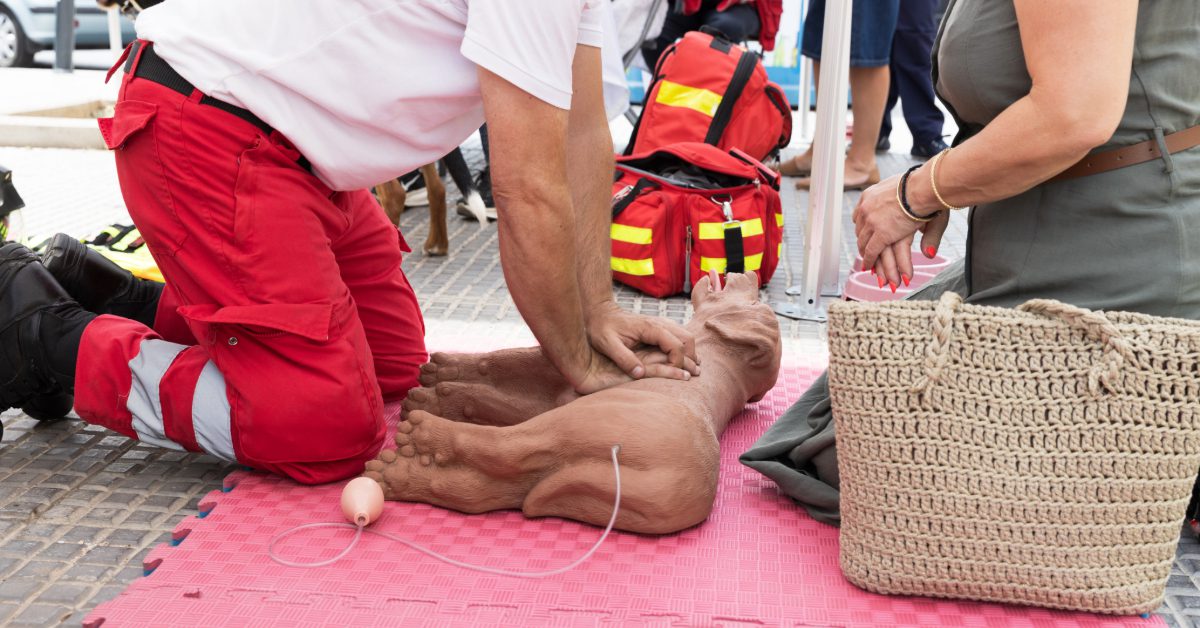
What Is Dog CPR and When Is It Needed?
Canine CPR or cardiopulmonary resuscitation is an emergency procedure used to manually support a dog’s breathing and circulation when the heart has stopped beating or the dog has stopped breathing on their own. Just as human CPR combines chest compressions with rescue breaths to keep oxygenated blood moving to vital organs, dog CPR follows the same principle adapted for a dog’s anatomy.
CPR for dogs is only appropriate in a true emergency, specifically when a dog is unresponsive, unconscious, not breathing, and has no detectable heartbeat. It is not a substitute for professional veterinary care, it is a bridge to get your dog to an emergency vet as quickly as possible. Every second matters in a cardiac or respiratory emergency, so understanding the basics of canine CPR before an emergency occurs is critical.
How to Check If Your Dog Needs CPR
Before beginning CPR, you need to quickly assess whether your dog is actually in cardiac or respiratory arrest. Starting CPR on a dog that is breathing and has a pulse can cause serious harm, so a quick assessment is essential.
Check for Responsiveness
Call your dog’s name and gently tap or shake them. If they do not respond at all (no movement, no reaction, no attempt to get up) they may be unconscious. An unresponsive dog needs immediate evaluation.
Check for Breathing
Watch for chest movement and listen for breath sounds. You can also hold the back of your hand near your dog’s nose and mouth to feel for airflow. If you see no chest rise and feel no air movement, your dog is not breathing and CPR may be necessary.
Check for a Heartbeat or Pulse
To check for a heartbeat, place your hand or ear against your dog’s left side, just behind the front leg at the point of the elbow. You can also check for a femoral pulse on the inside of the upper thigh. If you cannot detect a heartbeat or pulse, CPR is indicated. Have someone call Ann Arbor Animal Hospital immediately while you begin.
The Basics of How to Perform CPR on a Dog
Dog CPR follows the same ABC framework as human CPR: Airway, Breathing, and Circulation. The specific technique varies slightly depending on the size of the dog, but the general steps are consistent. This overview is intended to give you foundational knowledge. It is not a replacement for a certified pet first aid and CPR course, which we strongly encourage every pet owner to complete.
Step 1: Open the Airway
Lay your dog on a flat, firm surface on their right side. Gently tilt the head back slightly to straighten the airway, and carefully pull the tongue forward to make sure it is not blocking the throat. Look into the mouth for any visible obstructions and remove them if you safely can.
Step 2: Give Rescue Breaths
Close your dog’s mouth and lips with your hand to create a seal. For medium to large dogs, place your mouth over your dog’s nose and blow gently until you see the chest rise. For small dogs and puppies, you may need to cover both the nose and mouth with your mouth. Give two rescue breaths, allowing the chest to fall between each breath. If the chest does not rise, recheck the airway position.
Step 3: Begin Chest Compressions
For most dogs, place the heel of one or both hands over the widest part of the chest, just behind the front leg. Compress the chest by one-third to one-half of its width. For barrel-chested breeds like Bulldogs, compressions may work better with the dog on their back. For small dogs, wrap your hand around the chest and compress with your thumb and fingers. Aim for 100 to 120 compressions per minute, following a ratio of 30 compressions to 2 rescue breaths.
Step 4: Continue and Get to a Vet
Continue the cycle of 30 compressions and 2 rescue breaths without stopping. Check for a pulse or signs of breathing every two minutes. If possible, have someone else drive while you continue CPR on the way to the hospital. Do not stop CPR until your dog shows signs of recovery or your veterinarian takes over care.
Dog CPR by Size: What Changes
One of the most important things to understand about canine CPR is that technique varies significantly based on a dog’s size and chest shape. Using the wrong technique can reduce the effectiveness of CPR or potentially cause injury.
Large and Medium Dogs
For dogs over 30 pounds with a typical chest shape, use two hands stacked on top of each other over the widest point of the rib cage. Apply firm, steady compressions. The depth should be enough to compress the chest by about one-third to one-half.
Small Dogs and Puppies
For small dogs under 30 pounds, use one hand or for very small dogs and puppies, use two fingers. Position your hand or fingers over the heart, located on the left side of the chest just behind the front leg. Be gentle but firm; you still need adequate compression depth to move blood effectively.
Deep-Chested and Barrel-Chested Breeds
Breeds with deep, narrow chests (like Greyhounds or Dobermans) and breeds with round, barrel-shaped chests (like Bulldogs and Pugs) require modified positioning. Barrel-chested dogs are often positioned on their backs for compressions, while deep-chested dogs benefit from compressions placed directly over the heart rather than the widest point of the chest.
Why Every Dog Owner Should Take a Pet CPR Course
If you’re wondering, “Can you give a dog CPR?” reading about dog CPR is a great starting point, but hands-on training is what actually prepares you to perform it under pressure. Pet first aid and CPR courses teach you to practice on training mannequins, build muscle memory for compressions and rescue breaths, and develop the calm focus you’ll need in a genuine emergency.
Organizations like the American Red Cross offer pet first aid certification courses both in person and online. Many local animal hospitals, humane societies, and pet training facilities also offer classes or can offer guidance on where classes are available. Getting certified doesn’t take long, and the knowledge you gain could save your dog’s life.
CPR Is a Bridge, Not a Replacement for Emergency Vet Care
It’s important to understand that canine CPR is meant to keep your dog alive long enough to receive professional medical treatment. Even if your CPR efforts appear to be working, your dog still needs immediate emergency veterinary care. Your veterinarian can identify and treat the underlying cause of the cardiac or respiratory arrest, administer medications, provide oxygen therapy, and monitor your dog’s recovery.
If your dog experiences any kind of medical emergency (e.g., difficulty breathing, collapse, loss of consciousness, or another life-threatening situation), contact Ann Arbor Animal Hospital or the nearest emergency veterinarian immediately. Do not wait to see if your dog improves on their own.
Be Ready Before an Emergency Happens
The best time to prepare for a pet emergency is before one ever occurs. Knowing the basics of dog CPR, having your emergency vet’s number saved, and understanding what signs require urgent care all make a real difference when time is critical.
At Ann Arbor Animal Hospital, we are committed to supporting you with the knowledge and care your dog deserves in every season of their life. If you have questions about your dog’s health, want guidance on emergency preparedness, or need to schedule a wellness exam, our team is ready to help. Call us at (774) 662-4475 today. Because the more prepared you are, the better protected your dog will be.
Recent Posts
About Us
Ann Arbor Animal Hospital is a locally-owned animal hospital operating for over 90 years in Ann Arbor, MI.